October 22, 2025
Aubrey Dunne
Ubotica’s North Star
At Ubotica, our north star is simple: make satellites intelligent so the world can see, predict, and act in time. Running powerful AI on the spacecraft is how we get there.
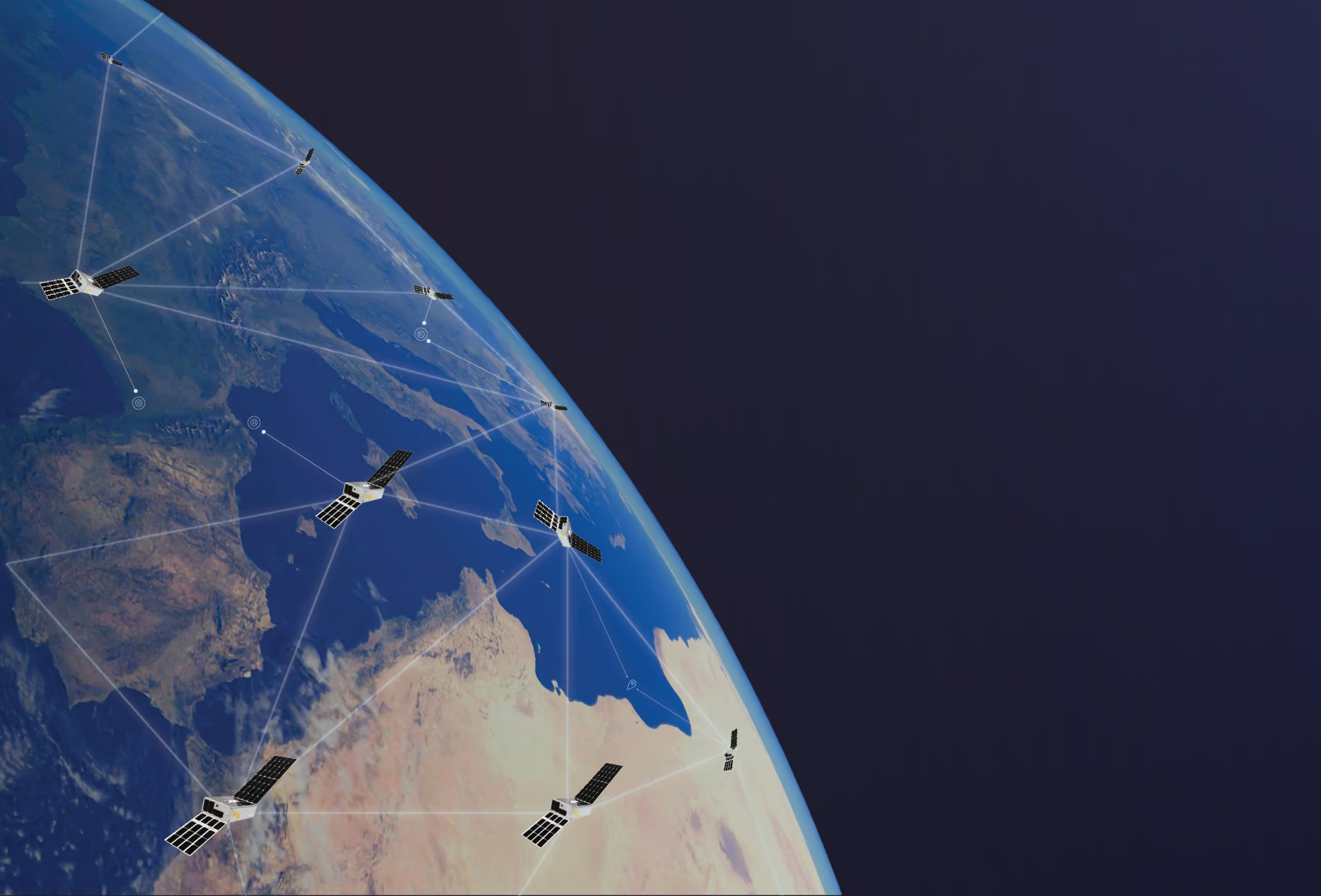
When a vessel goes dark near critical subsea infrastructure, every minute matters. A SPACE:AI-enabled satellite detects the vessel, processes imagery on-board, and alerts operators in near real time—because the thinking happens in orbit, not days later on the ground.
But scaling this capability hits two walls: models become too large for space deployment, and labels are too expensive to generate. Our latest research tackles both—shrinking models so they run fast at low power on flight-class hardware, and training without human labels by learning from a larger model’s predictions.
The Dual Challenge
Size & Power: Foundation model ViTs like Prithvi and TerraMind are superb—but at ~86M and 103M parameters, they’re impractical for many satellites. Our student model (MobileNetV2+UNet) is ~3.73M parameters—~23–28× smaller and built for on-board use.
Label Scarcity: High-quality EO labels (flood boundaries, crop classes, vessel types) are costly and slow to produce, especially for rare events and new regions. Our question: can a small model learn from a big model’s outputs instead of human labels—and still generalise?
Our Solution: Teacher-Supervised Learning
We leveraged knowledge distillation—essentially, having a large “teacher” model train a small “student” model. Our student architecture (MobileNetV2+UNet with just 3.73 million parameters) is 23–28× smaller than the teacher models.
But we pushed further. Instead of just using the teacher to supplement labeled data, we asked: What if the teacher’s predictions could replace human labels entirely? If this works, we eliminate the annotation bottleneck for many tasks. The teacher becomes a “labeling oracle” that enables rapid model development without expensive manual annotation campaigns.
Testing the Hypothesis
We tested on two real-world Earth observation challenges:
- Sen1Floods11: Flood Detection — A binary classification task (water vs. not-water) with 446 labeled images. Critically, it includes an out-of-distribution test dataset (Bolivia dataset)—a completely different geographic region that tests whether models truly understand floods or just memorized training locations.
- Multi-Temporal Crop Classification — A complex 14-class problem using temporal satellite imagery across the continental United States. This tests whether teacher supervision scales to nuanced, multi-class scenarios.
Two Training Strategies
- Strategy A: Blended Learning — The student trains on both real ground truth labels and the teacher’s final-layer outputs, with a parameter controlling the balance.
- Strategy B: Pure Teacher Supervision — The student trains on the teacher’s predictions as pseudo-labels, in place of the ground truth. No human annotations. This directly tests whether we can bypass manual labeling entirely.
Results: Strong Performance, Especially for Generalization
Flood Detection: Excellent Results
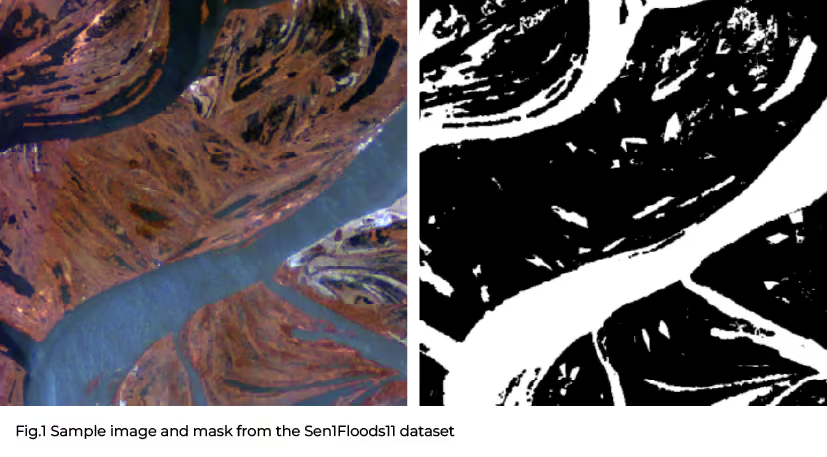
- Prithvi as teacher: Standard test: 0.873 Dice (vs. 0.892 with real labels); Bolivia test: 0.845 (vs. 0.853 with real labels).
- TerraMind as teacher: Standard test: 0.899 (vs. 0.914 with real labels); Bolivia test: 0.866 (vs. 0.886 with real labels).
The teacher-supervised student achieved 95–98% of baseline performance and generalized remarkably well to the unseen Bolivia region.
Crop Classification: Good with Room for Improvement
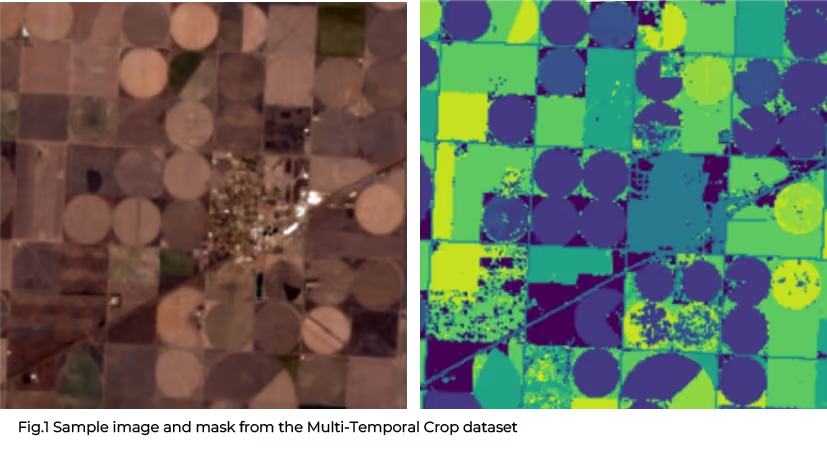
- Prithvi as teacher: Test with real labels: 0.435 Dice score; Test with teacher predictions: 0.375 (about 86% of baseline).
Binary classification is more forgiving than 14-way classification. With more classes, teacher errors compound during student training. However, 0.375 without any human labels is still a viable starting point for many applications.
The Efficiency Payoff: Space-Ready Performance
Our student models run efficiently across satellite-suitable edge AI hardware:
- Snapdragon DSP: 637 FPS at 6.44W
- NVIDIA Orin Nano: 132 FPS at 5.43W
- MemryX MX3: 114 FPS at 4.15W
- Myriad X (heritage platform): 12 FPS at 3.11W
Even on power-constrained hardware, we achieve real-time performance. Knowledge distillation makes cutting-edge AI practical for space.
Real-World Impact on Live Maritime Intelligence
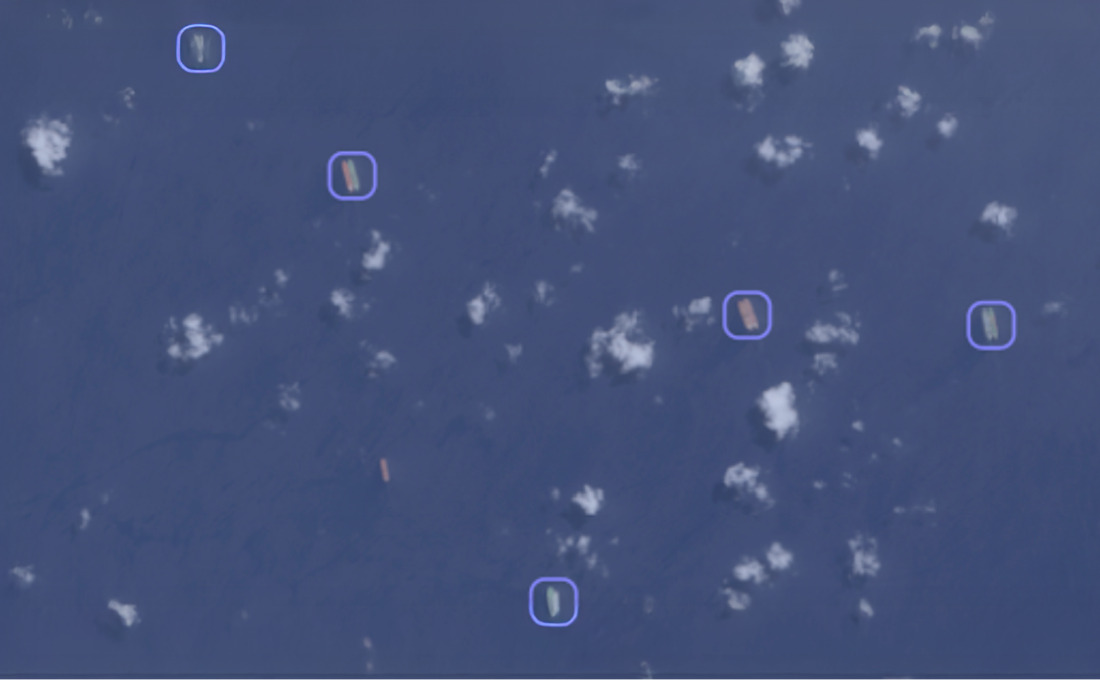
This research directly informs our LMI service:
- Faster fielding: Fine-tune a foundation model on the ground, then distill to a tiny flight model—no large annotation campaign required.
- Geographic transfer: The strong Bolivia results validate our maritime surveillance approach. A model trained on one region generalizes to new regions—critical for global infrastructure monitoring.
- Continuous improvement: As foundation models improve, we distill that knowledge to onboard models, creating an upgrade pathway for existing satellites.
- Lower barriers: Organizations can develop custom EO applications without investing heavily in annotation infrastructure.
Key Insights
- Teacher quality is paramount. Student performance ceiling is set by teacher accuracy.
- Task complexity matters. Teacher supervision excels for tasks with clear decision boundaries.
- Unlocks EO’s killer app. On-orbit inference compresses decision lead time from minutes to seconds.
The Road Ahead
We’re exploring more complex knowledge distillation approaches that better address multi-class problems and segmentation tasks with imbalanced datasets.
Conclusion: Foundation Models Meet Operational Reality
The AI revolution in Earth observation risks being Earthbound if we can’t deploy capabilities where they matter most—onboard the satellites capturing data.
Our research shows that knowledge distillation with teacher supervision removes two major barriers: model size and labeling costs. For binary and low-class-count problems, teacher-supervised students match traditionally trained models while generalizing to new regions. For complex tasks, there’s a gap, but results are encouraging enough to guide real deployments.
At Ubotica, this research directly informs how we build SPACE:AI capabilities today. Every insight about efficient training, improved generalization, and energy savings translates to more capable satellites delivering Live Maritime Intelligence when and where it’s needed.
With onboard AI powered by efficiently distilled models, satellites can watch, understand, and respond in real-time. When a dark vessel approaches critical infrastructure, our satellites know—immediately. That’s the future we’re building.