Satellites used to send back data. Ours send back answers.
Traditional Earth observation was built to collect first and understand later. Ubotica puts AI onboard, so satellites can detect and act in seconds. This is not a roadmap. Our intelligence stack is already flying.
Mission success
Models
Inferences
Detection


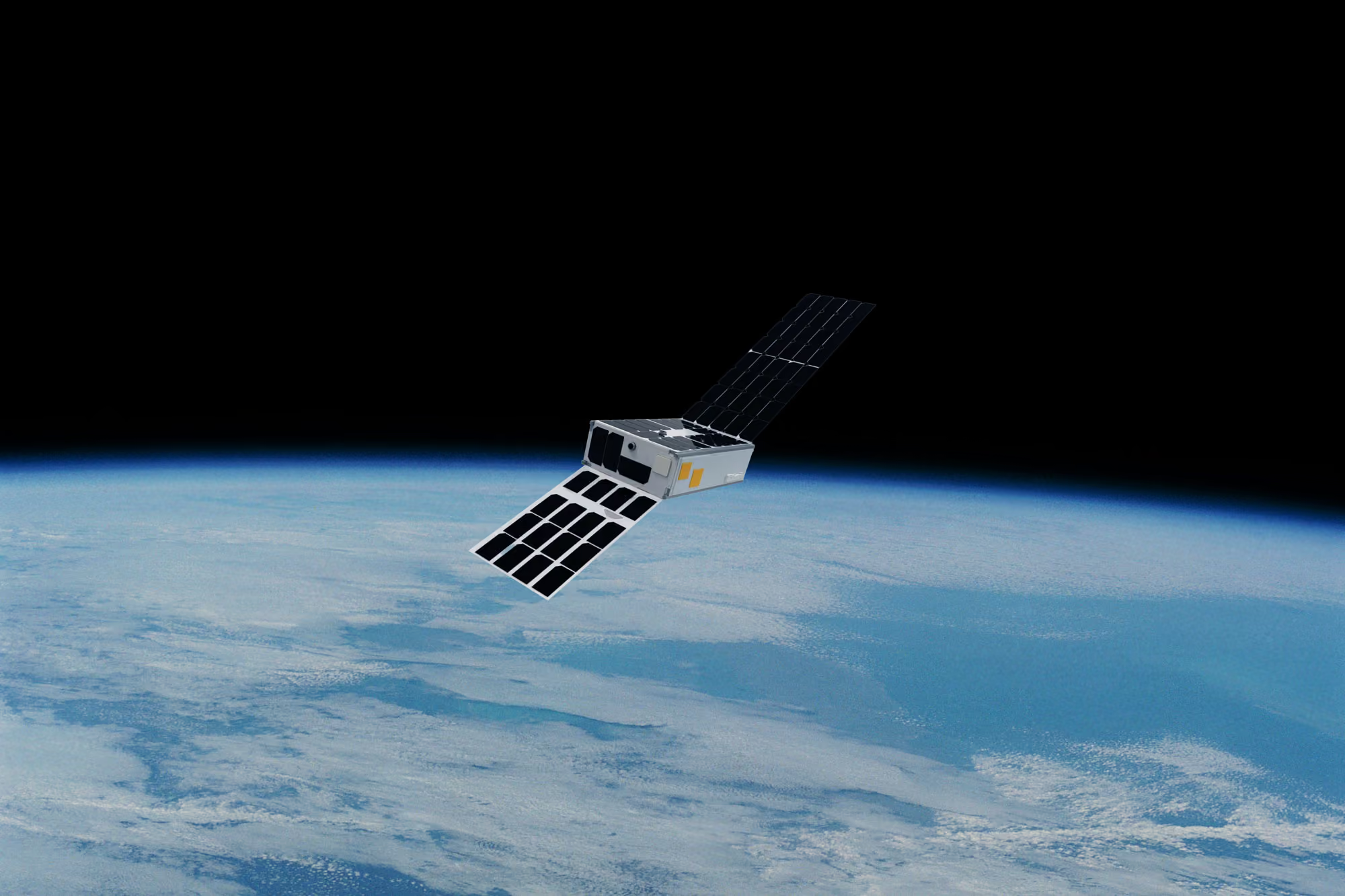
CogniSAT-6 is a CubeSat built with Open Cosmos, carrying Ubotica's Orbital AI.
It is a pathfinder. What is proved here propagates across the network Live Maritime Intelligence draws on.
CogniSAT-6 analyses what it captures while still in orbit. An 800 km² scene is processed in around 90 seconds. Vessels are detected, sized and given a heading onboard, and what leaves the spacecraft is a 200-byte message instead of a 3 GB file.
The answer reaches the ground in under ten minutes, against the hours a conventional downlink takes. Nothing waits until an analyst opens an image.
In July 2025, with NASA's Jet Propulsion Laboratory, CogniSAT-6 became the first Earth-observing satellite to look ahead along its own orbit, judge what was worth imaging, and retarget itself with no human involved. Tilted forward, it images the ground 500 kilometres ahead, reads that scene onboard, and returns to nadir in time to take the shot.



Launch:
January 2025
AIX processes optical and Earth observation data directly in orbit using Orbital AI, delivering Live Earth Intelligence for real-time threat detection, automated maritime monitoring, and on-demand cloud processing.

Launch:
November 2025
Accenture-1 delivers Live Earth Intelligence directly from orbit, combining hyperspectral imaging with Orbital AI to drive real-time decision-making and autonomous satellite operations.

Launch:
August 2024
Kanyini harnesses hyperspectral sensing, Orbital AI, and IoT connectivity in orbit to deliver Live Earth Intelligence for Earth observation, smart agriculture, and environmental management.

Launch:
March 2024
Mission goal is to successfully demonstrate the design, launch, deployment, and operation of SmallSats and their payloads.

Launch:
March 2024
Demonstrate successful SmallSat & payloads build, launch, deployment and operations.

Launch:
March 2024
Mission goal to demonstrate real-time insight delivery, autonomous AI-driven scheduling; deploy commercial edge AI solutions for insight extraction and delivery; operate on hyperspectral imager data.

Launch:
November 2023
Demonstrate multispectral and IoT applications in-orbit.

Launch:
November 2023
Demonstrate multispectral and super-resolution applications in-orbit.

Launch:
June 2021
To Demonstrate on-orbit hardware-accelerated inference and radiation–tolerant advanced heterogenous computing technologies.

Launch:
February 2022
Running CogniSAT in collaboration with NASA JPL, Spaceborne Computer-2 validated Ubotica's edge AI platform aboard the International Space Station, providing reliable autonomous computing in space.

Launch:
September 2021
Mission goal is the World-first demonstration of hardware-accelerated AI inference on a CubeSat.